Online casino game categories, compared by pace and by what you can check
Slots are only one family of games. This guide walks through live dealer tables, crash games, fishing and arcade titles, lotteries and bingo — what each one is, how fast it moves, and the single number that governs what it costs you.
 By TK666 Guide Editorial Team · Updated
Live dealer tables
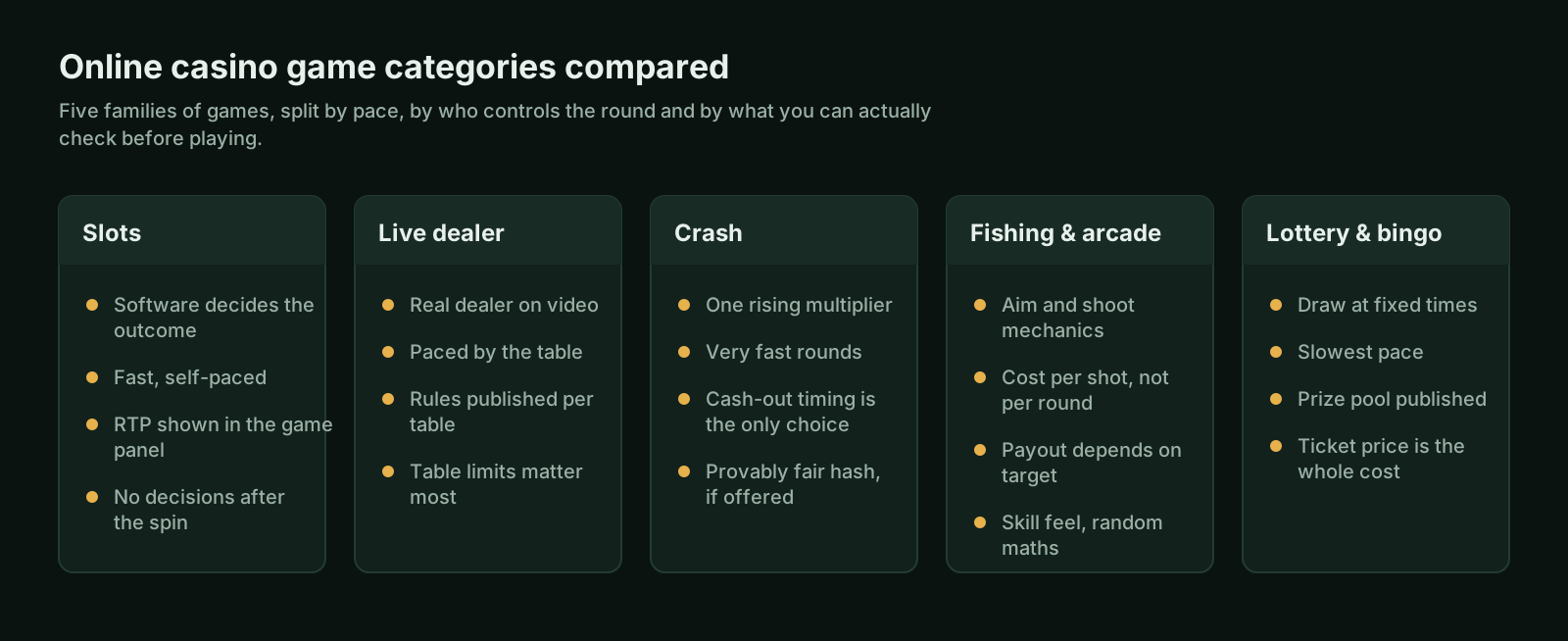
A real dealer runs a real table on camera; you bet through the interface. Rules and payouts are published per table, which makes live games the most transparent category on any platform.
What to look at: the table limits first, the specific rule variations second. In blackjack, whether the dealer stands on soft 17 changes the house edge measurably; in roulette, a single-zero wheel is meaningfully better than a double-zero one. Side bets are almost always the worst value on the table and are placed most often by new players.
Live games suit people who want a slow, visible round and dislike not knowing what the software is doing. They suit impatience poorly — you cannot speed the table up.
Crash and instant games
A multiplier rises from 1.00 and stops at a random point. You cash out before it stops or lose the stake. There is exactly one decision per round and it is a timing decision.
The appeal is transparency: a single number, a single choice. The risk is pace — rounds last seconds, and auto-cash-out makes it possible to stake a large amount in a few minutes without noticing. If a provably fair hash is offered, the verification instructions are usually one click from the game; using them once is worth the five minutes.
Fishing and arcade games
You aim at moving targets and pay per shot rather than per round. Different targets carry different multipliers and different difficulty, so cost per hit varies with your choices — which is why these games feel like skill games.
The part worth internalising: the cost meter runs continuously. In a slot you know a spin costs 5 taka; in a fishing game, holding the fire button for ten seconds might cost thirty times that. Watch the balance rather than the round.
Lottery, bingo and keno
Draws happen at fixed times, tickets have fixed prices, and prize pools are published in advance. The pace is the slowest in the casino, which for many people is the point.
The trade-off is that the edge is usually higher than on slots or table games, and it is easy to overlook because each ticket is cheap. Cheap and frequent adds up the same way expensive and rare does.
Choosing by pace, not by theme
| Category | Rounds per hour, typically | What you control | What to check first |
|---|---|---|---|
| Slots | Several hundred | Stake and when to stop | RTP and volatility in the panel |
| Live dealer | 30–60 | Bet type and table choice | Table limits and rule variants |
| Crash | Up to several hundred | Cash-out timing | Auto-cash-out settings and pace |
| Fishing / arcade | Continuous | Aim and fire rate | Cost per shot, not per round |
| Lottery / bingo | A few | Ticket count | Draw schedule and prize pool |
The column that decides how much a session costs is the second one. Everything else is preference.
The practical takeaway. Pick a category by the pace you actually want, check the one number that governs cost in that category, and be aware that the games which feel most like skill are the ones where the cost meter is hardest to watch.
Frequently asked questions
Which category is best for a beginner?
Live dealer tables with published rules and low limits are the easiest to understand, because you can see the round happen. Slots are the easiest to start but the hardest to judge, since the maths is invisible.
What does "provably fair" mean on crash games?
It means the round's outcome is derived from a seed committed in advance, so you can verify afterwards that it was not changed. It proves the round was not manipulated. It does not mean the game has no house edge.
Are fishing games skill games?
Partly. Aiming and target choice affect cost per hit, but payouts are still governed by random maths with a house edge. Treat the skill element as pacing, not as an advantage.
Why do live tables have such different limits?
Tables are segmented by stake so the pace suits the players at them. Always check the minimum and maximum before sitting down — the limit, not the rules, is what usually surprises people.
Do lottery and bingo games have better odds?
Not inherently. They have a slower pace, which means fewer decisions and less money staked per hour. That is a real difference in cost, but not a difference in edge.
Which category loses money fastest?
The fastest one you play at the highest stake. Crash and slots allow several rounds per minute; a live table might allow one. Pace multiplied by stake is the whole equation.
Before you open an account
Four things worth checking first, in this order:
- The licence entry in the regulator's own register — not a badge in the site footer.
- The domain, character by character: clones of popular brands are common.
- That the wallet you deposit with is in your own name, or withdrawals will fail verification.
- The bonus terms — wagering multiplier, what it applies to, game weighting and the deadline.
The button below is an affiliate link. If you open an account through it we may be paid a commission. It costs you nothing and does not change what we write.